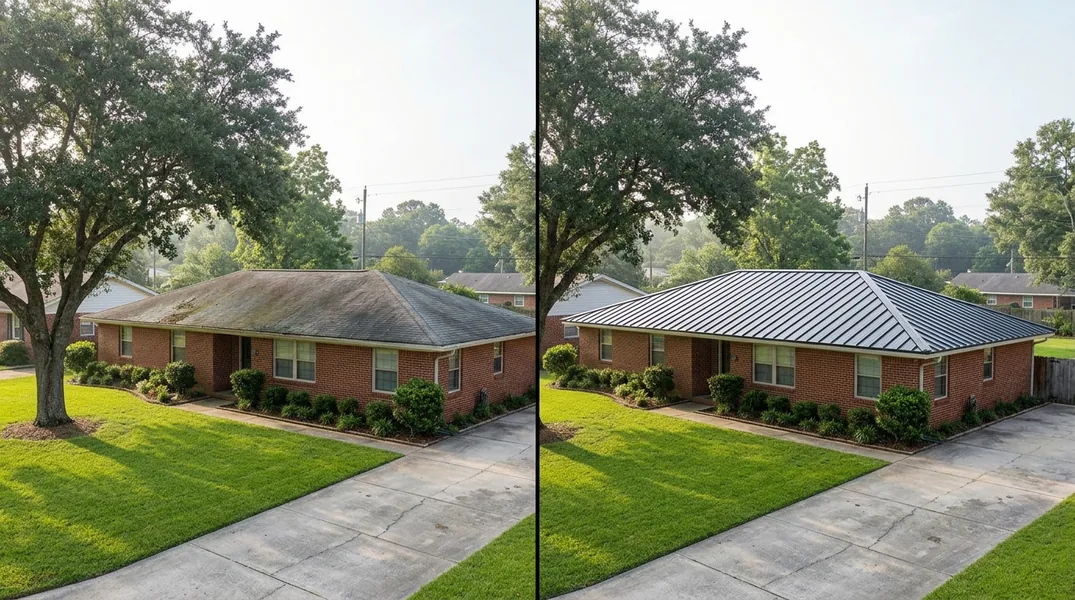
Why Tornado Season Demands a Serious Look at Your Roof
If you have lived in Montgomery for more than a year, you already know the routine: spring brings warm, unstable air, and with it the kind of severe thunderstorms that can spin up tornadoes with little warning. Alabama sits squarely in one of the most active severe weather corridors in the country, and the Montgomery area has seen its share of damaging wind events. For homeowners, that reality turns the roof over your head into more than a cosmetic feature. It is your first line of defense against uplift, flying debris, and driving rain.
Traditional asphalt shingles can perform reasonably well in ordinary storms, but their failure point tends to arrive sooner than most people expect. Once wind speeds climb and shingle edges begin to lift, the entire field of shingles can peel back in a matter of seconds, exposing the decking and inviting water intrusion. That is precisely why so many homeowners in the region are now asking about a wind rated metal roof. A properly specified and installed metal roof is engineered to resist the forces that tear conventional roofs apart, and understanding the ratings behind that performance helps you make a confident decision.
What Wind Ratings Actually Mean for a Metal Roof
When you see a metal roof described as wind rated, the number attached to it is not marketing fluff. It reflects standardized testing that measures how much negative pressure (essentially suction from wind trying to lift the panels) a roof assembly can withstand before it fails. Ratings are typically expressed in miles per hour, and the better systems are tested well above 140 mph. For context, an EF2 tornado carries winds of 111 to 135 mph, and an EF3 reaches 136 to 165 mph. A roof rated to 140 mph or higher gives your home a genuine margin of safety in the kinds of storms that produce tornado warnings across central Alabama.
It is important to understand that the rating belongs to the entire assembly, not just the metal panel. The panels, the fasteners, the clips, and the attachment to your roof deck all work together. A standing seam panel with concealed fasteners generally outperforms an exposed-fastener panel because there are no screw heads for wind to catch and no washers to degrade over time. That is one reason Standing Seam Metal Roofing has become the preferred choice for storm-conscious homeowners. The interlocking seams distribute wind load across the whole roof rather than concentrating it at individual fastening points.
How Metal Roof Wind Resistance Compares to Shingles
The difference in metal roof wind resistance comes down to physics and attachment. Asphalt shingles rely on a self-sealing adhesive strip and a limited number of nails per shingle. In high wind, those adhesive strips can fail, and once one shingle releases, the ones around it become far more vulnerable. Metal panels, by contrast, are continuous sheets that cover large areas with fewer seams and a mechanical attachment designed specifically to resist uplift. When you choose Metal Roof Installation with a system rated for high winds, you are essentially upgrading the structural envelope of your home.
There is also a practical, long-term advantage worth considering. After a major storm, shingle roofs often need patching or full replacement, and the cost adds up over the life of the home. A quality metal roof that has been correctly installed and rated for the local wind zone can weather multiple storm seasons without the same cycle of repair. Many homeowners in Prattville and Millbrook have made the switch for exactly this reason: they want a storm roof Alabama families can rely on year after year, not a patchwork of replacements. If your current roof is nearing the end of its service life, a Metal Roof Replacement may be the smarter long-term investment.
Installation Details That Determine Real-World Performance
A high wind rating on a product data sheet means little if the installation does not honor the manufacturer's specifications. Proper decking condition, correct fastener selection and spacing, and precise panel engagement are all critical. In our region, installers must also account for the way wind interacts with roof edges, ridges, and penetrations, since those are the areas most prone to uplift. A qualified crew will pay close attention to edge metal, closure strips, and the fastening pattern at the perimeter, because that is where storms usually find the weak link.
Homeowners sometimes ask whether they can save money by layering metal over an existing shingle roof. The answer depends on the structure and local code, but when done correctly, Metal Roof Over Shingles (Retrofit) can be a practical option that preserves the original roof as an underlayment. What matters most is that the retrofit is engineered and installed to achieve the intended wind rating, not simply fastened down as a cosmetic cover. If you are unsure which approach suits your home, a professional assessment is the right first step, and you can request a free estimate to get clear answers.
Metal Roof Installation Near Me: Choosing a Storm-Ready Contractor
Searching for metal roof installation near me in the Montgomery area will return plenty of options, but not every contractor is equally prepared for the demands of storm-resistant roofing. Look for a company that can explain wind ratings in plain language, show you the specific testing behind a product, and describe how fasteners and edge details will be handled on your particular roof. Ask whether the installer follows the manufacturer's installation instructions, because deviating from them can void the very warranty and rating you are paying for. A brief conversation usually reveals whether you are dealing with a knowledgeable professional or a salesperson reading from a brochure.
It also helps to work with a local crew that understands central Alabama weather patterns and building practices. A team based in the area can assess your roof, recommend a system appropriate for the local wind exposure, and stand behind the work when the next storm rolls through. Whether you are in Wetumpka or closer to downtown, choosing an experienced local installer is one of the most important decisions you will make in the entire process. When you are ready to talk specifics, call Montgomery Metal Roofing at (334) 781-4583 to discuss your options and schedule an assessment.
What to Budget for a Storm-Ready Metal Roof in Montgomery
Homeowners naturally want to know what a wind rated system will cost. Metal roofing generally carries a higher upfront price than asphalt shingles, but the gap narrows when you factor in longevity, lower maintenance, and reduced storm repair costs. The final figure depends on the size and complexity of your roof, the panel profile you select, whether a tear-off is required, and the condition of the underlying decking. A straightforward ranch home will cost less than a complex roofline with multiple valleys and dormers, and a retrofit over existing shingles can change the equation as well.
Rather than guessing, the most reliable path is to get a detailed, written proposal based on an on-site inspection. That way you can compare systems on an apples-to-apples basis and see how the wind rating, warranty, and installation details differ. You can review general pricing guidance online, but a personalized estimate is what actually tells you what your home needs. For homeowners who want peace of mind before the next tornado season, that conversation is well worth having. Reach out to Montgomery Metal Roofing today to get started.
Looking for a professional metal roofing contractor in Montgomery? Montgomery Metal Roofing responds fast for all your metal roofing needs.
Get a Free QuoteOur services: Metal Roof Installation · Standing Seam Metal Roofing · Metal Roof Replacement